
How to Choose a Lab Coat Suitable for Healthcare Professionals?
The lab coat, also called laboratory coat, is an essential piece in every medical professional's wardrobe. Designed to protect and identify healthcare personnel, the famous "white coat" must be chosen carefully. Several criteria must be considered so that the lab coat is comfortable, hygienic, and flattering. We examine here two main criteria: the material and the size.
What material to choose for a lab coat?
The ideal choice is a 100% cotton lab coat or one made from a hybrid polyester-cotton fabric (called polycotton). This type of professional clothing provides the user with protection against splashes while offering good comfort.
100% cotton is perfect for activities exposed to splashes, such as in laboratories or hospitals. It resists high-temperature washing, which is essential in medical environments. Light and absorbent, it can however wrinkle easily.
Polycotton proves more resistant and doesn't wrinkle. However, the fabric remains more delicate and doesn't withstand high-temperature washing.
These two fabrics are used in a very large number of medical coats and lab coats, in hospital environments, laboratories, clinics, or dental offices.
At Beauty Street, we offer lab coats made with high-quality technical fabrics. Discover our complete collection to find the professional clothing adapted to your needs.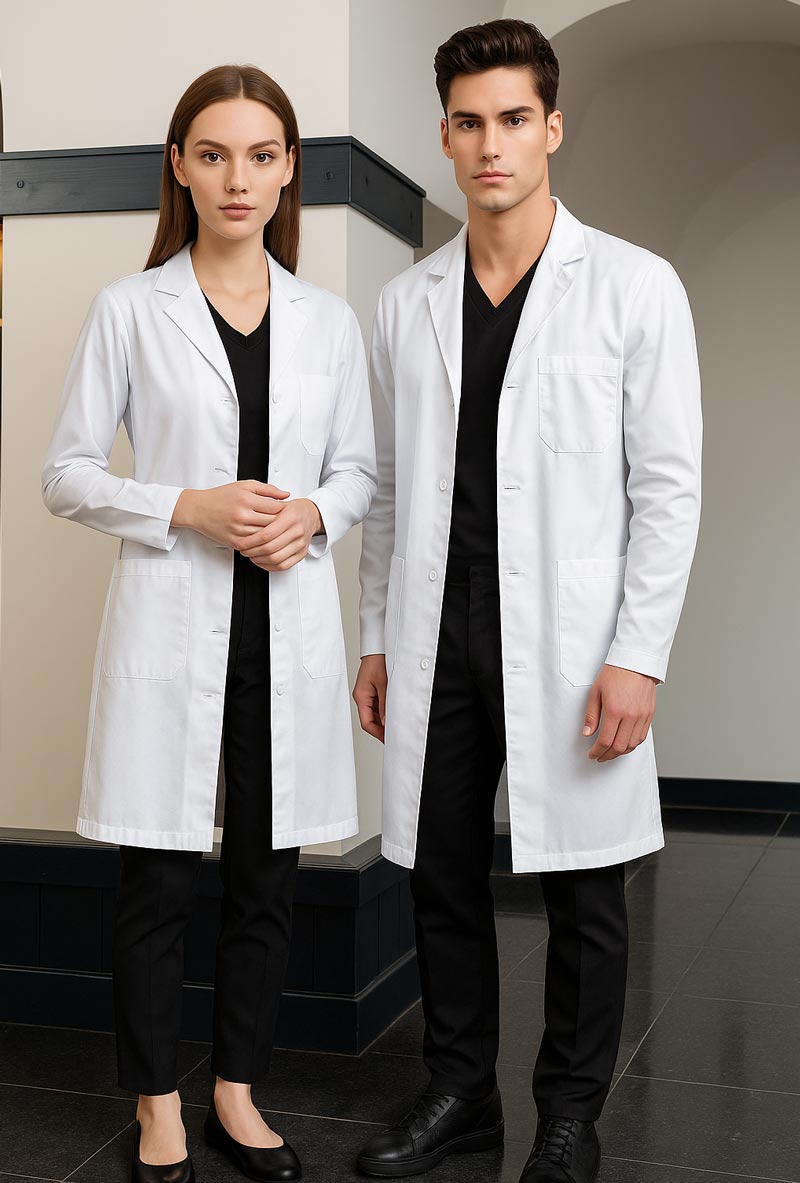
What size to choose for a lab coat?
The choice is first established according to the person's morphology. The lab coat should be neither too long nor too short. Ideally, it should cover the clothes well to protect them effectively.
The sleeve length is also of paramount importance. It's preferable that the coat covers the forearms well, but that the sleeves aren't too long to prevent the practitioner from floating in them. A professional coat that's too loose can create the risk of accidentally dropping instruments on the floor or worse, on a patient. The lab coat must therefore be well-fitted to the person using it. This rule isn't necessarily to be followed for practitioners working in fields requiring impeccable daily hygiene. In medicine, one should rather opt for short sleeves that facilitate frequent washing of hands and wrists between each patient.
Obviously, beyond the purely practical aspect, this professional clothing must also please its user. Favoring a fitted or loose cut according to one's tastes and silhouette remains a matter of personal style. Once technical obligations are met, the choice of cut also relies on aesthetic criteria.
To conclude, choosing a lab coat relies on two essential criteria: a material that guarantees safety, hygiene, and ease, and a cut that perfectly adapts to each profession's requirements.
Share this content